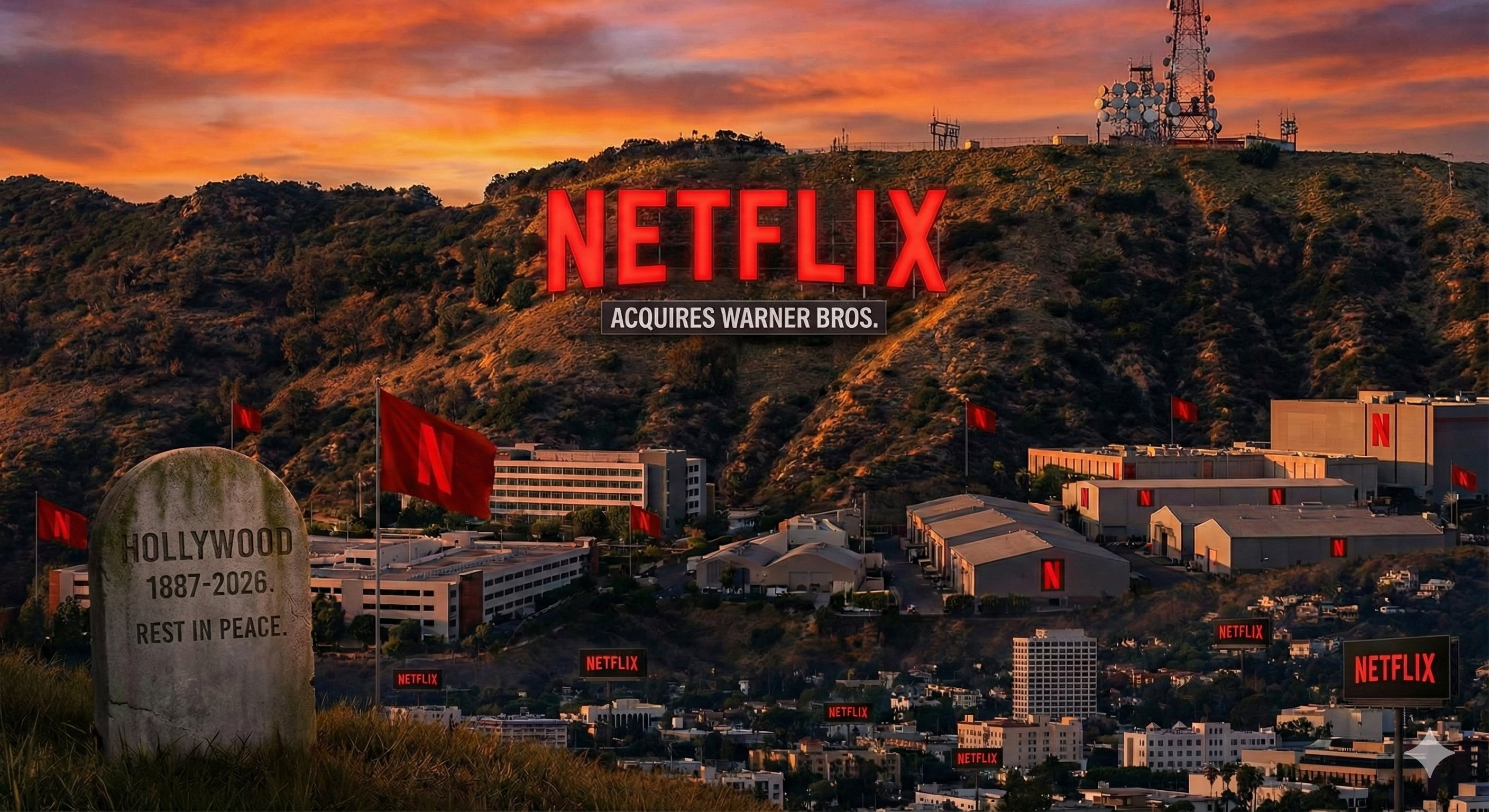
The entertainment world froze on Friday. In a move that redefines the concept of a “blockbuster,” Netflix has announced a definitive agreement to acquire Warner Bros. Discovery (WBD). This isn’t just a merger; it is the end of the Streaming Wars as we knew them and the beginning of a new, monopolistic era in Hollywood.
If you are trying to make sense of the headlines, here is the deep dive into what is actually happening, why it matters, and why this deal is far from a done deal.
What is Netflix Actually Buying?
It is crucial to understand that Netflix is not swallowing Warner Bros. Discovery whole. The deal is structured to strip WBD of its declining assets before Netflix takes the keys.
-
The “Crown Jewels” (What Netflix Gets): Netflix is acquiring the Warner Bros. film and TV studios, the HBO brand, and the Max streaming service. This is the content engine. It includes a century of legendary IP: Harry Potter, Game of Thrones, the DC Universe (Batman, Superman), Friends, and the prestigious HBO back catalog (The Sopranos, The Wire).
-
The “Linear” Spinoff (What is Left Behind): Netflix has zero interest in the declining cable television business. Therefore, before the deal closes, WBD will spin off its linear networks into a new, separate public company tentatively called Discovery Global. This new entity will own assets like CNN, TNT Sports, The Discovery Channel, and Eurosport.
In short: Netflix gets the premium content library and the subscribers; the cable channels are being cast off into a separate life raft.
Why Acquire Now? The Strategic Shift
For over a decade, Netflix preached “organic growth,” insisting it didn’t need to buy legacy studios. Why the sudden U-turn?
-
The IP War is Lost (Without Help): While Netflix conquered the technology of streaming, Disney has consistently held the advantage in intellectual property (Marvel, Star Wars). By acquiring Warner Bros., Netflix instantly gains a library that rivals the Mouse House. They no longer have to build every franchise from scratch; they are buying Batman, Hogwarts, and Westeros.
-
Vertical Integration: This turns Netflix into a true Hollywood studio with physical lots and theatrical distribution capabilities. It signals a move away from just being a “tech platform” to being the definitive home of cinema history.
-
Churn Reduction: HBO/Max was arguably Netflix’s highest-quality competitor. Owning it consolidates the market, reduces the number of subscriptions a household needs, and theoretically lowers churn.
The Price Tag: A Balance Sheet Breaker?
The numbers are staggering, and they represent a massive departure from Netflix’s financial discipline.
-
Total Enterprise Value: ~$82.7 Billion.
-
Per Share Offer: $27.75 per WBD share.
-
The Mix: Shareholders will receive $23.25 in cash and ~$4.50 in Netflix stock.
Does it make sense? To finance the cash portion, Netflix has secured a $59 billion bridge loan from Wall Street banks. This heaps a “mountain of debt” onto a balance sheet that was previously pristine compared to legacy media peers. Strategically, Netflix is betting that the perpetual cash flow from the Warner library will service this debt. However, financially, it leaves the company highly leveraged and vulnerable to interest rate shifts—a risk Netflix has never had to manage at this scale.
Wall Street’s Reaction: Cold Feet
The market reaction was swift and skeptical, reflecting the immense risks involved.
-
Netflix (NFLX): Shares dropped ~3-5%. Investors dislike the uncertainty and the dilution from issuing new shares. More importantly, they are worried about the massive debt load and the distraction of a complex integration.
-
Warner Bros. Discovery (WBD): Shares rose, but they are trading significantly below the offer price of $27.75. This “arbitrage spread” is Wall Street’s way of saying, “We don’t think this deal will actually close.”
Investors are voting with their wallets, signaling that the regulatory hurdles may be insurmountable.
The Paramount Threat: “Rigged” Process?
The drama isn’t just between Netflix and regulators. Paramount Skydance (the recently merged entity led by David Ellison) is furious and making noise.
-
The Higher Bid: Reports indicate Paramount offered $30 per share (higher than Netflix’s $27.75) and is now accusing the WBD board of breaching their fiduciary duty by accepting a lower, riskier bid.
-
The Threat: Paramount is threatening a hostile bid and shareholder lawsuits, labeling the process “rigged.”
-
The Politics: David Ellison has close ties to the political sphere. There are rumors Paramount may lobby the administration to block the Netflix deal on antitrust grounds, hoping to swoop in as the backup buyer if the government kills the Netflix agreement.
The “Poison Pill” Defense: Stopping a Hostile Takeover
With Paramount threatening to bypass the board and appeal directly to shareholders (a “hostile bid”), Warner Bros. Discovery is expected to deploy a “Shareholder Rights Plan,” commonly known as a poison pill. This is the nuclear option of corporate defense.
-
The Trigger: The board sets a “tripwire” threshold, typically at 15% ownership. If Paramount acquires more than this amount of WBD stock without board approval, the pill is activated.
-
The “Flip-In” Mechanism: Once triggered, every shareholder except Paramount is given the right to purchase additional WBD shares at a massive discount (often 50% off).
-
The Result (Dilution): The market is flooded with cheap new shares. This instantly dilutes Paramount’s stake—turning a potential 15% holding into a trivial 2% or 3%—and makes it mathematically impossible and prohibitively expensive for them to acquire a controlling interest.
Essentially, the poison pill forces Paramount back to the negotiating table, preventing them from seizing control of the company against the board’s wishes.
The Long Road Ahead: Why the Deal is Not Done
Signing the paper was the easy part. Closing this deal will be a brutal, multi-year slog.
-
The Spinoff Pre-Requisite: WBD must first successfully spin off “Discovery Global,” a complex financial maneuver not expected to complete until Q3 2026.
-
The “Regulatory Nightmare”: This is the biggest hurdle. A merger of the #1 (Netflix) and #4 (Max) streamers creates a dominant player with over 30% market share. The DOJ, FTC, and EU regulators will scrutinize this aggressively.
-
The Breakup Fee: The risk is priced in. Netflix agreed to a massive $5.8 billion breakup fee. If regulators block the deal, Netflix has to pay WBD nearly $6 billion just for walking away.
In conclusion, Netflix has made its boldest move ever, attempting to buy a century of Hollywood history. But with Paramount sabre-rattling, a massive debt load, and regulators sharpening their knives, we are likely looking at a court battle that drags into 2027. The Streaming Wars might be ending, but the Legal Wars have just begun.